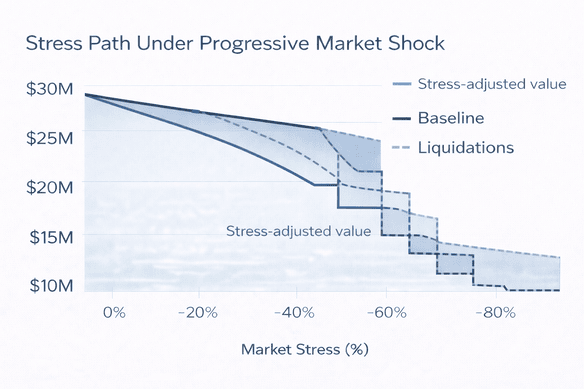
Crypto Security Rests on Three Pillars
Cryptography and code prevent exploits.
Economic and liquidity integrity determine whether systems survive stress.

Cryptography & Mathematical Guarantees
What can be proven
Keys, signatures, and consensus rules define what should be secure under ideal assumptions.
This layer protects against invalid transactions — not market stress.
Code & Implementation
What can be audited
Smart contracts, protocol logic, and audits reduce implementation risk and prevent known classes of bugs.
This layer limits technical failure — not economic breakdown.

Economic & Liquidity Integrity (Frith Labs)
What fails under stress
Whether a system remains solvent, liquid, and coherent when markets move faster than assumptions.
- Liquidity evaporates before price gaps
- Liquidations cascade across positions and protocols
- Solvency breaks at the protocol layer, not the asset level
Frith Labs focuses here.
We analyze economic stress, liquidity failure, and systemic fragility —before price reflects it and before losses become irreversible.